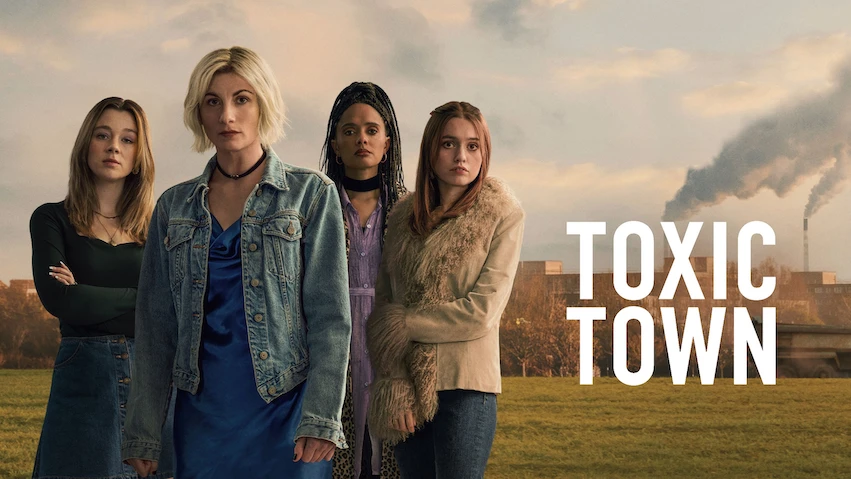
Toxic Town is a new limited series that fictionalizes the true story of one of the biggest environmental scandals to occur in the UK, and the subsequent fight for justice. It’s a narrative centered around several women who could be called unlikely warriors: a tight-knit group of mothers who want answers about what has happened to their children — and why.
The women at the heart of the series — Susan McIntyre (Jodie Whittaker), Tracey Taylor (Aimee Lou Wood), and Maggie Mahon (Claudia Jessie) — are fighting a true David and Goliath-style battle as they seek accountability from the Corby Borough Council. It’s no wonder the story has been called a “British Erin Brockovich,” as both the film and the series present dramatized accounts of real legal battles, and hit on common themes of empowerment and fortitude in the face of corruption.
Another thing the series and film share is a tenacious lawyer at the center of it all, steering the case through a legal system that is anything but straightforward. In Toxic Town, that lawyer is Des Collins (Rory Kinnear), who represents the Corby mums in their case.
The series version of Des is fictionalized, but watching it was still a “slightly unnerving” experience for the real Des Collins, as we learned from speaking to him recently. As Collins says, he had to tell himself while watching Kinnear portray a dramatized version of his character, “No, that’s a script. It’s not you talking, it’s someone else talking.”
Below, we talk with Collins and Erin Brockovich about their experience with the Corby case, what it’s like to take on powerful entities, and the message they hope Toxic Town viewers will take with them after watching the series.
How did you first get involved with both the original Corby case, and then the series that was inspired by it?
Collins: I was first involved with this back in 1999, and it was quite accidental. I was just reading a newspaper — and in fact using the newspaper as kindling for a fire. I read the article in the Sunday Times, because I always use the best newspapers for the fire. [laughs]
And I saw the article in the paper and I thought, “Oh, I know about Corby because I went to school there until I was 12.” Every time I’ve said anything to people about going to school in Corby, they always say, “Well, where is it?” I got hold of [the writer of the article] and said, “What more can you tell me about this?” And he introduced me to Susan [McIntyre] and Susan and I got on very well together and that's how we met … The rest, as they say, is history.
I’m very glad that it didn’t just become kindling in your fire. It is such an interesting thing, that it’s happenstance that you discovered it at all. It really does show what a fine line it is between something being potentially put in, if not the dustbin, the fireplace of history, versus things actually moving forward and having the opportunity to affect real change.
Collins: It’s very much about the right place at the right time, the right circumstances. It might never have happened, but there we are. Life changes.
Erin, what about you? The themes of community and empowerment are so strong in Toxic Town, which is something you’re very familiar with. What was your involvement in this situation?
Erin Brockovich: I have to say this first: I’m sitting over here beaming ear-to-ear and I want you to know why — Des, you are so much like Ed Masry, who Albert Finney played in the film Erin Brockovich. Just everything about you — your knowledge, your humor, and your heart. These can be really rare qualities that we don’t see anymore. So I want to say to you, Des, with the highest compliment in the world, how much you remind me of Ed Masry, and thank you for everything that you’ve done and how special you really are.
But you’re right, it happens by happenstance and oftentimes these things go unnoticed. I always look back on that case that started the film Erin Brockovich. Had any one person or event been out of step or out of time, it wouldn’t have come together.
There’s something very mysterious, yet magical in how it happens. Some people say it’s fate when it all comes together. I was approached by some of the [Corby] moms … It is generally a person in the community [who leads a campaign like this]; more often than not, it’s a mom. They’re worried that there’s something wrong with the children or they’re showing signs of issues, which clearly was happening out there. And they have a big challenge, because oftentimes people don't believe it. I’ve done this for 30 years, and they think, “Oh, mom’s just overly concerned,” or that this isn't really happening. There’s always pushback. And this is where Des is so amazing. It lends a larger credibility in a big environmental case to the community, to the moms, [when someone says,] “No, you're actually right.” Then that’s where the digging and the law and everything merges together to start uncovering and telling and showing the story of what actually happened to the community.
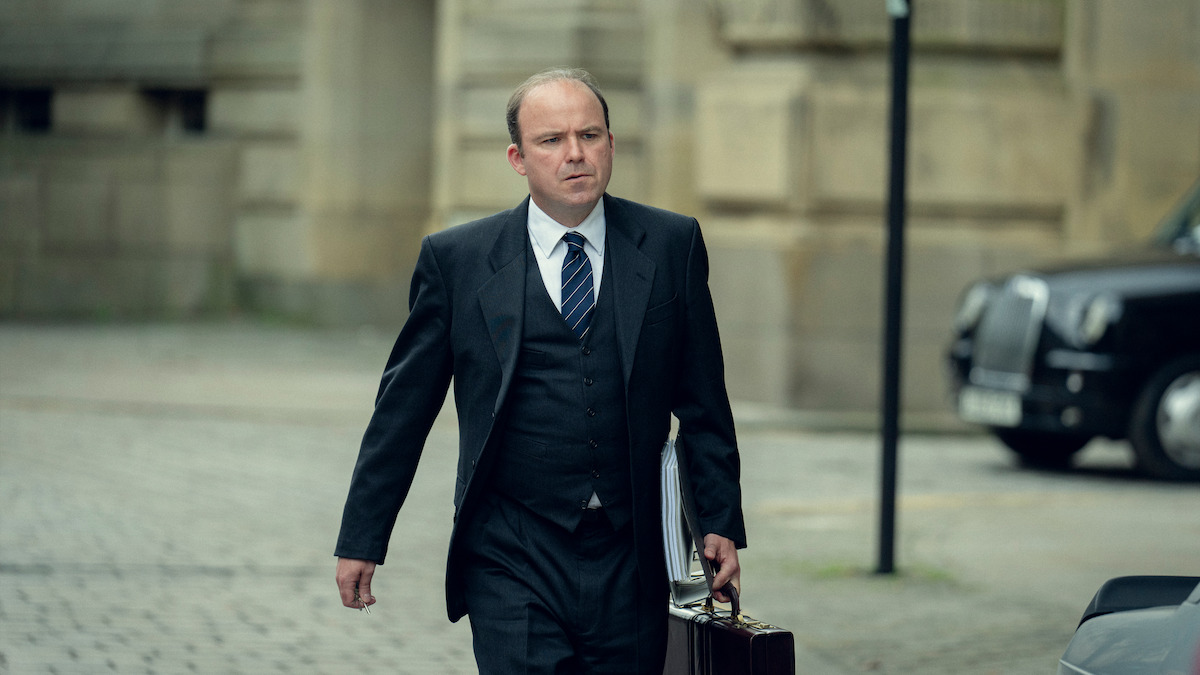
Rory Kinnear as Des Collins in Toxic Town
BEN BLACKALL
When you watched the series, Des, did it take you back to what that experience was like for you?
Collins: It was slightly unnerving in a way, because watching the series and listening to [Rory Kinnear] who was playing me say things … you realize, “No, that’s a script. It’s not you talking, it’s someone else talking.”
All this happened the best part of 25 years ago and the case took 11 or 12 years to conclude. At the time, it was the longest case I’d ever been involved in and it was an education in a number of ways, in that the learning to work with and understand how the mothers felt was something which took some time to come to terms with. I went to school in Corby. I know what the Corby ethos is, and I thought I could understand what they were trying to communicate, and I could understand the fact that they didn’t feel that they were getting listened to properly by anyone else.
Of course, a lot of people would sit down [with them] and say, “Yes, yeah, of course, there, there. We can do this for you, we can do that for you. We understand what the problems are.” But in actual fact, no one was listening, no one was understanding. We came along and picked up the case and they were very grateful that we came along, because at least they had a lawyer who was listening to them.
But, of course, my experience as their lawyer when I talked to the defendants or the council was pretty much what theirs had been: “Go away, stop bothering us, you’re a nuisance. You don’t know what you're doing. We’re the council. We can sort this out. And if you really try to do anything, we’ll destroy you. We’ve pretty much destroyed your clients. Don’t think you are above that.” So the whole process was one of continuing education.
How do you stay strong through something like that? What is it that helps you keep going?
Collins: I think the short answer to how you keep going is: It depends on the sort of person you are. I’m the sort of person who — well, clearly I don’t give in easily, because that’s what the case tells everyone. But, the fact that they were treating the mothers the way they were treating them, I find excruciatingly annoying. You can use a lot of other words for it, but I just find it annoying. Who are you to tell these women what to think? And that they can’t think, and they don’t know? And I found that was something I had to get to grips with.
Then, of course, there was an attitude of, “Well, you don’t know the town, because we are the councilors. We run this town and you work in another part of England, you’ve just been shipped in here to try and sort this out and you just don't understand how it works in Corby.” But I was able to tell them, yes, I did understand how it worked in Corby. I went to school there until I was 11 and my parents lived there for about 50 years. So I knew what the town was like. So the whole process, the harder they fought against it, the more determined I became.
Sometimes when you’re working on a case like this, you find that you are very determined, but the clients become very disillusioned. But what I found was that the more determined I became, the more determined the clients became. And we were almost fighting each other, saying, “No, we’ll do it.” “We’ll do it, I’ll do it.” “You do it.” “No, stop it. We can all do it.”
Eventually we did it together, which is the right way. But you need that degree of determination, not only from the legal side but from the client side. And in that case we had it.
This is, of course, a very local story, rooted in a very specific community, but it has a universally resonant message. What do you think it is about stories like this that are so important to get out into the broader world?
Collins: I think what’s important about stories like this is that the story is about real people doing real things in real time effectively and achieving a result. We know good doesn’t triumph over evil all the time, but it’s quite nice occasionally just to see that happen. Because if you lose your faith or your belief that that can happen, you become so disillusioned. As a lawyer, I’ve been fighting cases all my life; I’ve won a few and I’ve lost a few, but if I lost them all, I’d probably give up. So it’s good to see. I think the world likes to see that sometimes, surprisingly enough, good will triumph over evil. I think that’s important.
Erin, do you have anything to add to that?
Brockovich: For me, watching the series, at the end I found myself jumping up off the couch. “You did it!” The twists and the turns and the agony of everything that’s gone on, it gives us hope. When you go through battles like this, it’s easy to lose your hope. It’s easy to just give up sometimes and go away, but you don’t.
I’ve just watched this play itself out for 30 years in my work, over and over again. It’s important to be there. It’s important to feel and understand what somebody else is going through. You become a support for each other. When I began my work, I could feel that with the people. And it’s very obvious that’s what happened with Des and his community. And the cycle continues to repeat. You win some and you lose some, but boy howdy, when you see the win and you haven’t seen one in a while and the world can be a daunting place, it just reignites hope and inspires you and it empowers you to say, “You know what? They did that. And I can rise up and I can do that, too.”
This interview has been edited and condensed for clarity.